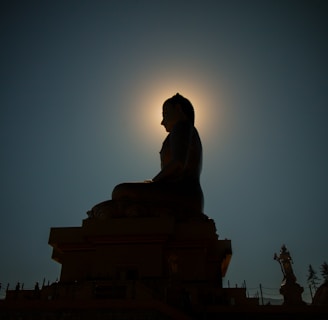
Buddha and Jesus: Anatta, the Kingdom Within, and the Illusion of the Separate Self
The Interconnectedness of Buddha, Jesus, and All
We are deeply conditioned to view ourselves as isolated individuals navigating a competitive, fragmented reality. But, if we actually ask ourselves 'What Would Buddha Do?' and 'What Would Jesus Do?' how might we answer these questions and where might that lead?
These questions can lead us to a distant, historical, outdated code or, when we look through centuries of institutional dogma, political sanitization, and mythic additions, they can lead us to the realization that they were not simply offering lessons in morality; they were offering paths to freedom via a shift in consciousness—a shared, empirical roadmap leading away from the delusions of the ego and into a state of liberation- peace within interbeing.
By looking at their core psychological and mystical teachings and by examining the earliest available writings—such as the Pali Canon and the earliest synoptic gospels—we can perhaps see how dissolving the illusion of the separate self changes how we live, breathe, and react to the world around us. In doing so, we uncover a profound redefining of freedom and 'salvation': it is not a deferred transaction for a future heaven or a reward after death but an immediate psychological liberation from the root of suffering—the ego—right here and Now.
A Core Metaphysical Truth: The Illusion of the Separate Self
At their foundational core, the teachings of Buddha and Jesus converge on a singular metaphysical truth: humanity (and all we perceive) is fundamentally interconnected, and the illusion of a separate, isolated self is the root of all suffering. This core insight unites the deepest currents of ancient spiritual philosophy in a radical shift of perspective: moving from the illusion of the independent individual to the realization of universal interconnection. Both teachers recognized that human suffering stems from this delusion of the separate self and both offered a psychological and existential path into a state of absolute, shared oneness.
While the Buddha used the psychological frameworks of non-self (Anatta) and dependent origination (Paticca-samuppada ) to dissolve the ego, Jesus pointed to the same reality through mystical teachings on the immanent "Kingdom of God within," the childlike mind, and the commandment to love one's neighbor as oneself.
The Buddha: Anatta and the Interdependent Web
In the early discourses of the Pali Canon (the closest records we have to the historical Buddha's words), the Buddha diagnosed human suffering (dukkhā) not as a moral punishment or a sin but as a cognitive error. We instinctively feel like we have a fixed, permanent, unchanging soul, essence, or ego (Atta, or Atman in Sanskrit), and the idea of a self within a larger Self existed at the time of the Buddha. But the Buddha departed from contemporary Hindu ideas and taught Anatta—the realization of "non-self."
In the Anatta-lakkhana Sutta (The Discourse on the Characteristic of Non-Self), the Buddha breaks the human being down into five components—the Khandhas or aggregates: form, sensation, perception, mental formations, and consciousness—and demonstrates that none of them are permanent, static, or under our absolute control. As recorded in the Samyutta Nikaya (22.59):
"Consciousness is not self. If consciousness were the self, this consciousness would not lead to affliction... But because consciousness is not self, consciousness leads to affliction."
If there is no fixed, standalone "I," what are we? The Buddha answered this with the doctrine of dependent origination (Paticca-samuppada) which states that everything arises in dependence upon multiple, fluid causes and conditions. We are not separate dots; we are an intricately woven fabric. As the early texts succinctly put it in the Udana (1.1):
"When this is, that is; from the arising of this, that arises. When this is not, that is not; from the cessation of this, that ceases."
We are not static things; we are dynamic, interconnected processes. When a person realizes that the boundary between "self" and "other" is merely a mental construct, the grasping, clinging, and aversion that cause suffering can dissolve, giving way to universal loving-kindness (Metta) and compassion (Karuna).
Practices
To shift this from an intellectual concept into an embodied, lived reality, the Buddha provided a system of mental training, somatic awareness, and ethical action:
Insight Meditation (Vipassana): The systematic observation of the mind and body. By sitting silently and watching thoughts, physical sensations, and emotions arise and pass away, the practitioner directly witnesses that there is no solid "manager" behind the curtain—only a fluid stream of changing conditions.
Lovingkindness Cultivation (Metta Bhavana): A structured meditation where goodwill is intentionally generated and directed outward. It begins with the self, moves to a loved one, a neutral person, a difficult person or enemy, and ultimately radiates out to all sentient beings. This practice actively thins the egoic wall dividing "my happiness" from "their happiness."
Continuous Mindfulness (Sati): Bringing absolute presence to mundane movements. In the Satipatthana Sutta, practitioners are instructed to remain fully aware while walking, standing, sitting, eating, and moving. This breaks down the narrative ego by grounding the practitioner entirely in the present sensory reality, leaving no room for the artificial "story of me."
Generosity (Dana): Cultivating a disposition of open-handed generosity. By giving away material goods, time, or energy without expecting a return, a person actively deconstructs the illusion of ownership and starves the ego's instinct to hoard and protect its borders.
Ethical Conduct / The Five Precepts (Sila): Committing to non-harming (abstaining from killing, stealing, sexual misconduct, lying, and intoxication). Sila is a practical recognition of interdependence. To harm another is understood to be a direct assault on the collective ecosystem of which you are a part.
Jesus: The Immanent Kingdom and Radical Oneness
Where the Buddha used analytical psychology to deconstruct the ego, Jesus used the language of mystical intimacy to achieve the exact same collapse of separation. When Jesus spoke of the "Kingdom of God," early synoptic gospels show he was not referring to a faraway sky-world in the clouds nor was he pointing to a delayed apocalyptic future event.
By interpreting the Kingdom as a post-mortem destination or an end-of-the-world catastrophe, later institutional dogmas pushed Jesus's message out of the present moment. But Jesus himself explicitly rejected this as a futuristic view. In Luke 17:20-21, when asked by the Pharisees when the Kingdom of God would come, he replied:
"The kingdom of God cometh not with observation: Neither shall they say, Lo here! or, lo there! for, behold, the kingdom of God is within you [or among you]."
The Greek phrase used here, entos hymon, points to an immediate, internal, and relational landscape. In the Gospel of Thomas (Saying 113), this present-moment mysticism is even more explicit:
"His disciples said to him, 'When will the kingdom come?' [Jesus said], 'It will not come by watching for it... Rather, the Father's kingdom is spread out upon the earth, and people do not see it.'"
To perceive this present reality, Jesus argued that the constructed, adult ego must be completely undone. We must unlearn our rigid concepts of social status, self-protection, and separation. As recorded in Matthew 18:3:
"Verily I say unto you, Except ye be converted, and become as little children, ye shall not enter into the kingdom of heaven."
A young child does not yet possess a hyper-rigid, defended ego. Children experience the world with a fluid, baseline sense of interdependence. Before they are conditioned, they do not see themselves as fundamentally detached from their environment or from others; they live in a state of open vulnerability, raw presence, and natural connection. To "become as little children" is to shed the armor of the narrative self—the adult identity built on labels, pride, and division—and return to a state of awareness that perceives reality as an interconnected whole.
When we look through these childlike eyes, the artificial lines between "me" and "you" vanish. This is why Jesus commands his followers to "love your neighbor as yourself" (Mark 12:31)- it is a profound metaphysical statement: Love your neighbor because your neighbor is yourself.
Mystical Oneness
This dissolution of the individual ego reaches its pinnacle in the Gospel of John, where Jesus describes his own identity not as a separate, isolated human ego, but as an open conduit totally unified with the divine source. Jesus rejects the idea of independent authorship or a standalone self. In John 5:19 and John 14:10, he states:
"The Son can do nothing of himself, but what he seeth the Father do... the words that I speak unto you I speak not of myself: but the Father that dwelleth in me, he doeth the works."
This perfectly mirrors the Buddhist concepts of Anatta and dependent origination—the individual "I" is not a solid entity; it is an open vessel through which the larger, interdependent reality flows. Because this reality is alive, fluid, and free from the static boxes of the ego, it cannot be institutionalized or pinned down. In John 3:8, Jesus describes this boundless, uncontainable movement of consciousness:
"The wind [or spirit] bloweth where it listeth, and thou hearest the sound thereof, but canst not tell whence it cometh, and whither it goeth: so is every one that is born of the Spirit."
The Spirit—much like dependent origination- is a dynamic process, not a fixed thing. It "blows where it will," ignoring human-made boundaries, tribal divisions, and individual walls. Furthermore, Jesus defines the goal of human spiritual evolution as the realization of this exact same absolute, shared interconnection. In his great intercessory prayer in John 17:21-23, he prays for all humanity:
"That they all may be one; as thou, Father, art in me, and I in thee, that they also may be one in us... I in them, and thou in me, that they may be made perfect in one."
We are not separate dots on a map; we are branches and manifestations of the universe. As Jesus says in John 15:5:
"I am the vine, ye are the branches: He that abideth in me, and I in him, the same bringeth forth much fruit: for without me ye can do nothing."
This is illustrated in Matthew 25:40, where Jesus equates how we treat the marginalized with how we treat the Divine:
"Inasmuch as ye have done it unto one of the least of these my brethren, ye have done it unto me."
This insight demands an absolute presence; it forces us out of waiting for a future kingdom and puts us directly into immediate reality. To harm another is to harm the vine; to love another is to recognize the shared life flowing through all the manifestations of the universe. This is the mystical foundation of Jesus's radical social critique, demanding a total breakdown of tribal, social, and egoic barriers in favor of a lived reality of absolute, shared oneness in the Now.
By firmly anchoring the Kingdom in the immediate Now, there is a transformation of spirituality from a passive waiting room for heaven into an active, urgent realization of a present metaphysical fact. This is the real gospel (euangelion, or "good news") and real salvation: it is not a deferred legal transaction to secure safety after death for a separate ego but an immediate transformation that liberates us from the illusion of the separate self entirely. When the vine is recognized as alive right here and Now, morality is upgraded from a checklist of rules to an experiential reality. We no longer love our neighbor out of a sense of standard duty but out of the immediate knowledge that their suffering is our suffering, and our mutual liberation is found in waking up to our absolute interconnectedness in the Now. Real salvation is freedom all suffering, from the sharpest agony to the subtlest threads of anxiety and existential angst, in the Now.
Practices
Jesus is portrayed as living a highly interactive, relational, and contemplative lifestyle designed to dismantle the ego's illusion of separation and be liberated in the Now:
Contemplative Meditation and Solitude (Slotha): Jesus frequently retreated to "desert places" or mountains alone to pray... When Jesus retreated to practice Slotha, he was entering a state of deep meditation—quieting the cognitive chatter of social identity, anxiety about the future, and egoic striving to align his awareness with the source and clear a channel for the divine current to flow through unblocked.
By clearing this internal channel, we can naturally tap into Shlama—the Aramaic word traditionally translated as "peace." Far from a passive state of quietness, Shlama translates linguistically to wholeness, completeness, and a state of unbroken harmony with the primordial source. It is an infinite peace because it represents a return to the boundless baseline of reality before the mind chopped it up into "me" and "not me," "self" and "other," and "God" as a separate, external agent. To rest in Slotha is to experience Shlama: an uncaused, infinite peace that remains perfectly still beneath the changing waves of the ego's daily dramas.
The Sacred Breath (Rukha d'Qoodsha) as a Contemplative Anchor: To achieve this, Jesus utilized a somatic, physiological focus identical to mindfulness of the breath (Anapanasati). The theological phrase "Holy Spirit" is translated from the Aramaic Rukha d'Qoodsha. Rukha means breath, wind, or invisible power (the linguistic equivalent of the Sanskrit Prana or Hebrew Ruach), while Qoodsha means sacred or cleared for a divine purpose. Thus, Jesus used the Sacred Breath as a physical anchor to ground his awareness in the Now. By tracking the rising and falling of the Rukha, the narrative self is dissolved, resulting in immediate experience of the Divine source.
Watchfulness of Mind (Nepsis): Rooted in Jesus’s instruction to "Watch and pray" (Mark 14:38), the Greek word Nepsis refers to a state of mental sobriety, alertness, and vigilance, operating as the exact functional equivalent of Sati (Mindfulness). Nepsis is the systematic practice of observing thoughts (logismoi) as they appear on the horizon of consciousness, intercepting them before they hook the mind into a cascade of egoic reactivity, craving, or aversion.
This is the precise psychological key to understanding the frequently misunderstood Parable of the Ten Virgins and the Oil Lamps (Matthew 25:1–13).
Traditional dogmatic interpretations weaponize this text as a moralistic warning about a future, linear apocalyptic event. However, viewed through a contemplative lens, the parable is an urgent lesson in resting in the Now. The oil represents the finite capacity of human attention and the psychic energy required to sustain bare awareness. The "foolish" bridesmaids are not morally evil; they are simply unmindful—their attention is scattered, allowing their energetic reservoir to be depleted by the cognitive chatter of past regrets and future anxieties. When the immediate reality of the Now arrives (the "bridegroom"), they are caught in darkness, trapped in the narrative, illusive self. Conversely, the "wise" bridesmaids practice rigorous Nepsis. They consciously hoard their "oil"—their present-moment attention—refusing to let it be stolen by the distractions of the world. They keep their lamps lit right here and Now, demonstrating that readiness for the Divine source is an active, continuous grounding in the absolute experience of the present.
This internal vigilance is what allows us to navigate the sudden exposure of psychological programming, a dynamic illustrated in another misunderstood story—Jesus's encounter with the Samaritan woman at the well (John 4:1-30). When Jesus exposes her relational history, he is not moralistically shaming her; he is acting as a perfect mirror, bringing her unconscious patterns into the light of bare awareness. Her immediate egoic reaction is defense and diversion—she attempts to shift the conversation into a theological debate about the past and future of proper worship. Jesus, practicing absolute Nepsis, catches this mental evasion neutrally, bypassing her conceptual smoke screens by declaring, "Yet a time is coming and has now come," radically redirecting her attention back to the absolute immediacy of the Now and the "living water" within. The text reflects this internal shift when she leaves her water jar—a physical manifestation of letting go of the ego's baggage and historical identity—and steps into the clear light of raw presence. Nepsis is this active guarding of the sense doors, ensuring your lamp never runs dry of the currency of presence, and your awareness is never hijacked by a story that distracts you from the Now.
Guarding the Heart with Single-Pointed Attention (Prosochē): This practice embodies Jesus’s instruction in Luke 11:34: "The light of the body is the eye: therefore when thine eye is single, thy whole body also is full of light." To keep the eye "single" (haplous) means to maintain uncompounded, pure, and undivided attention on the present moment. Prosochē is the continuous cultivation of internal self-possession, mapping directly onto Samadhi (Concentration). It is the real-time recognition that when attention becomes fractured by past regrets or future anxieties, the internal landscape plunges into darkness. By keeping the attention unified, the entire being fills with the clear light of raw presence.
Radical Forgiveness and the Erasure of Karmic Debt (Aphiemi): In the Lord’s Prayer, the phrase "forgive us our debts, as we forgive our debtors" relies on the Greek word Aphiemi (Matthew 6:12), which means "to send away, to let go, to discharge, or to untie." Far from being a soft moral platitude, this is a psychological tool designed to dissolve the ego. When the ego is wounded, its natural survival instinct is to loop around the grievance, generating resentment—which in Buddhism is the literal mechanism of creating Kamma (Karma), the conditioning that traps the mind in suffering. Practicing Aphiemi means actively untying and releasing that knot in the present moment. You let go of the debt because holding it reinforces the fiction of a separate, victimized "I." It is the functional application of Metta operating as an absolute solvent on egoic friction.
Non-Judgment as the Dissolution of Conceptual Labeling: Rooted in Matthew 7:1—"Judge not, that ye be not judged"—this practice is a direct assault on the ego’s primary boundaries. The separate self survives by constantly evaluating, categorizing, and labeling reality based on personal preferences (craving and aversion). In Zen and early Buddhism, true liberation requires halting this conceptual proliferation (papanca). When Jesus warns that the measure you mete will be measured back to you, he is detailing a psychological mirror: the more rigidly you judge and label your environment, the more rigidly imprisoned you become within your own mental constructs. Non-judgment is the practice of resting in bare awareness, experiencing the world as it is without the interference of the narrative self.
Turning the Other Cheek: Often misunderstood as passive submission, Jesus's command to "turn the other cheek" (Matthew 5:39) is a contemplative practice of non-retaliation and ego-disruption. In the ancient world, a slap on the right cheek was typically a backhanded blow delivered by a superior to insult and humiliate an inferior. By offering the left cheek, the practitioner refuses to participate in the egoic script of fight-or-flight, honor-and-shame. It is a physical act of radical presence that completely cuts through the reactive conditioning of the narrative self. It demonstrates that the separate identity cannot be threatened or diminished by external judgment, shifting the dynamic from a cycle of reciprocal harm into a space of unshakeable neutrality and awareness.
Radical Table Fellowship: In first-century Judea, eating a meal with someone was a strict boundary-marker of social purity, gender boundaries, and economic status. Jesus shattered this by intentionally dining with tax collectors, sex workers, and outcasts. This is a physical, embodied practice of disrupting social hierarchies to demonstrate that there is no "us" and "them" in the present Kingdom.
Kenosis (Self-Emptying): The practice of voluntary humility and service, epitomized by Jesus washing his disciples' feet (John 13:1-17). By placing oneself as a servant, the ego's demand for recognition, dominance, and "adult" social prestige is starved.
Loving the Enemy: Jesus radically extended the boundaries of the tribal ego by commanding his followers to "love your enemies and pray for those who persecute you" (Matthew 5:44). This psychological disruption directly attacks the ego's foundational mechanism: its need to define itself by what it opposes or hates- fundamental tribalism.
Voluntary Poverty and Simplicity: Jesus told his disciples to travel without a staff, a traveler's bag, bread, or money (Luke 9:3). By removing material safety nets, we are forced out of self-reliance and into a state of absolute, radical trust and interdependence with others.
The Intersection: Extinguishing the Illusion
Losing Oneself to Find Oneself: When Jesus speaks of losing oneself to find oneself, he is speaking the language of Anatta. In Mark 8:35, he states, "For whoever wants to save their life will lose it, but whoever loses their life for me and for the gospel will save it." In a non-mythological sense, "losing one's life" is the death of the ego—the shattering of the illusion of the isolated self.
The Imperial Co-optation: The corruption of these teachings happened similarly in both traditions, but most aggressively in Western Christianity. When the Roman Empire co-opted the Jesus movement in the 4th century, the radical, inward mystical realization of the "Kingdom within" was systematically replaced by an outward, imperial hierarchy that mirrored the institutions of the day. Jesus was transformed from a guide showing humanity its own divine, interconnected nature into an exclusive cosmic monarch who required appeasement. The message of union was replaced by a message of division (saved vs. damned).
Empirical Reality over Myth: The Buddha's and Jesus's actual insights require no mythic architecture. They are empirical observations about the human condition. We are expressions of the same unfolding universe—temporary waves rising out of the same ocean. When the wave realizes it is the ocean, fear dies, the fixed self dissolves, and genuine love becomes the only logical way to relate to the rest of reality.
Living the Synthesis (WWBD & WWJD)
When we integrate these, the questions of "What Would Buddha Do?" and "What Would Jesus Do?" merge into a practical framework for modern living. They are two sides of the same coin: the Buddha provides a psychology to dismantle the ego, while Jesus provides the expression of that dismantled ego through radical, self-sacrificing love.
What Would Buddha Do? (The Internal Shift)
In our daily life, WWBD means pausing before you react in anger, greed, or defensiveness. It means practicing Sati (mindfulness) and looking at your frustration to realize, "This anger is not 'me.' It is a temporary mental formation arising from conditions." By practicing mindfulness and meditation and recognizing Anatta, we can stop taking the ego's dramas so seriously. We can realize we are not isolated islands fighting against others but a wave as part of the same vast ocean.
What Would Jesus Do? (The External Action)
Once the ego's grip is softened, WWJD becomes a natural outward expression. Because understanding that the Kingdom is here and Now—not a reward waiting in the future or in the clouds—we are compelled to manifest it immediately. We drop the adult pretenses of judgment and separation, looking at the world with the open eyes of a child. WWJD means stepping into the world with active, courageous compassion. It means enacting Kenosis (self-empty service) and radical fellowship—looking at another person's suffering, even a supposed enemy's, and treating it as our own. We feed, comfort, and defend others because we recognize that we are both branches of the same vine, animated by a universe, energy, and Spirit that is pervasive and "blows wherever it will."
The Combined Path
Ultimately, to live this integrated path is to realize that wisdom (Buddha), no separate self/oneness (Buddha and Jesus), and lovingkindness (Jesus) are inseparable.
Without the psychological insight into Anatta and the grounding practices of mindfulness, our attempts to love like Jesus can become performative, exhausted, or corrupted by the ego's desire to feel "righteous," "holy," or superior.
Without Jesus's urgent, relational call to embody the Kingdom here and Now by becoming like children and loving our neighbor as ourself, our meditation can become an isolated, intellectual escape hatch—a subtle form of spiritual selfishness.
The most liberating truth of this combined path is that we ultimately do not need external teachers, rigid dogmas, or ancient scriptures to realize this awareness. These teachings were pointing to a timeless capacity already within us. We do not need a map once we have arrived home. By quieting the searching mind, we can drop the dependency on external structures and simply rest within—waking up to the reality that the infinite peace we are seeking is, and always has been, at the core of our being, within and without.
The Ultimate Anchor: The Middle Way and the Rejection of Extremism
Beneath all these practices lies a final, universal guardrail that both teachers insisted upon: the rejection of extremism in favor of the Middle Way. The ego is a master adapter; if it cannot defeat your spiritual practice through worldly distraction, it will co-opt the practice itself through fanaticism, rigid perfectionism, and self-flagellating discipline.
The Buddha, having nearly starved himself to death as an extreme ascetic, realized that a string tuned too tight will snap, while a string left too loose will not play. The Middle Way (Majjhima Patipada) was a departure from indulgent hedonism and violent self-mortification. It is the practice of gentle, precise, and sustainable balance.
Jesus mirrored this framework in his battles with the religious elites of the day. He repeatedly violated rigid, extremist Sabbath laws to heal the sick and feed the hungry, famously declaring that "The sabbath was made for man, and not man for the sabbath" (Mark 2:27). He rejected the dogmatic purity culture of extremism, choosing instead a fluid, compassionate presence that prioritized human suffering over ideological perfection.
To live this integrated path is to recognize that waking up to our universal interdependence cannot be achieved through egoic striving or dogmatic, fanatical warfare against our own humanity. True salvation is found in the quiet, unforced center. By dissolving the illusion of a separate self and walking a balanced, harmonious Middle Way, we lay down the weapons of spiritual pride and extremist judgment. We allow the mind to settle into its natural state: boundless, compassionate, and deeply interconnected, and rest in the universally available peace of the eternal presence, the Now.
Beyond the Biographies: The Buddha, The Christ, and Mythologies of the Mind
For centuries, people have approached the personhood of Buddha and Jesus with the tools of historical realism. They map births to ancient regions, debate exact timelines, and attempt to strip away the "supernatural elements" to find the real, flesh-and-blood men beneath. In viewing these stories purely as historical "facts," we miss extremely significant points.
In both Buddhist and Christian mystical traditions, the traditional narratives—from sheltered palaces and humble mangers to ultimate awakenings and resurrections—operate as profound psychological maps. These stories are not simply accounts of what happened to them; they are metaphors for what happens inside us when we “wake up.”
There are similar stories and messages from other cultures throughout history with different figures (Krishna, Osiris, Dionysus, Mithras, Mahavira, etc.), but we will continue with Buddha and Jesus to look at how the stories about them are relevant Now.
The Birth of Potential (The Manger and the Palace)
Both narratives begin by illustrating the dual nature of human consciousness: our deep immersion in the physical world, contrasted with our innate spiritual potential.
The Buddha’s Palace: Siddhartha is portrayed as being born a prince, surrounded by absolute luxury and shielded from suffering. This palace represents the prison of the ego. We all build our own palaces of comfort, status, and distraction, trying to lock out the fundamental anxieties of existence.
The Manger of Christ: Conversely, Jesus is portrayed as being in a stable among animals. This represents the divine spark born into the lowest, most vulnerable aspects of human nature. It symbolizes that the path to spiritual awakening does not require elite status; it begins precisely where we are—in the humble, raw, and unvarnished reality of everyday human life.
In both cases, this is considered an important event. Angels sing for Jesus; sages weep with joy for Siddhartha. These are mythological markers indicating that the birth of higher awareness within a person is significant, an event of cosmic importance to the writers of these stories.
The Crisis and the Call (The Sights and the Baptism)
Before the journey can truly begin, the illusion of ordinary life must be shattered.
Siddhartha ventures outside his palace and encounters the Four Sights—an old man, a sick person, a corpse, and a holy ascetic. These "Heavenly Messengers" represent the sudden, shocking breakdown of our illusion of permanence. It is the moment in life when our daily distractions fall away and we are forced to look directly at mortality.
Jesus’s journey accelerates at his Baptism in the Jordan River. Entering the water represents a psychological death to the old life and a rebirth into spiritual identity, marked by the sky opening and a dove descending.
Both motifs represent the Awakening of the Seeker. Whether triggered by existential grief (Siddhartha) or a profound spiritual calling (Jesus), the individual can no longer return to living unconsciously.
The Wilderness and the Shadow (Mara and Satan)
Immediately following their awakenings, both figures are driven into isolation to face tests of the human psyche: a direct confrontation with the ego.
The Buddha was tempted by Mara (Lord of Illusion), "Who do you think you are to be free?" The temptation represented anxieties and fears rooted in cravings, addictions, and attachments. Jesus was tempted by Satan (Adversary) to use spiritual power for material comfort and test reality or seek dramatic validation. He overcame any craving for political power, control, and worldly dominance.
Neither Buddha nor Jesus fights their adversary with physical violence. Buddha simply touches the earth, anchoring himself in steady presence. Jesus quotes scripture, refusing to engage with the illusions offered to him.
Mara and Satan are metaphors for the subconscious mind. When you sit down to deeply understand yourself, you are met with your inner demons. The victories in these stories show us the way: not to run from the shadow, nor to fight it. We simply recognize it, stay still, and refuse to let it dictate our actions.
Death, Rebirth, and the Ultimate Awakening
The pinnacles of both stories are metaphors for spiritual transformation.
Siddhartha sits beneath the Bodhi tree until his old identity dissolves completely, allowing him to wake up as the Buddha (the "Awakened One"). Jesus undergoes the crucifixion, entirely surrendering his personal will ("Not my will, but yours be done"), and rises as the Christ (the "Anointed One").
The Cross and Resurrection and the Bodhi Tree stories are symbols of the same psychological threshold: the death of the separate ego. To be reborn into a higher state of consciousness, the small, selfish, terrified version of who we think we are must be allowed to die.
These Myths are About the Human Experience
The ultimate message of these shared mythologies is that the stories are universal templates. "Buddha" and "Christ" are fundamentally titles, not proper names.
By structuring these lives as transformative journeys, these ancient traditions provide a mirror for the reader. The historical details of millennia ago are distant, but our inner landscape is identical. By navigating our palaces of comfort, facing down our wilderness demons, and surrendering our egos, we might just stumble upon our awakened nature.