Pantheism, Humanism, and Buddhism


The Synthesis of Pantheism, Humanism, and Buddhism
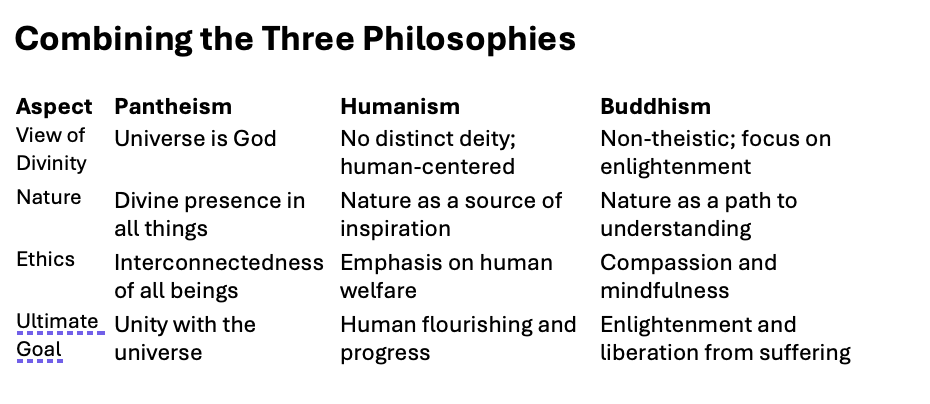
Combining pantheism, humanism, and Buddhism can create a worldview that sees the universe as divine (pantheism), emphasizes human values and ethics (humanism), and recognizes the importance of mindfulness and the nature of suffering (Buddhism). This synthesis encourages a deep appreciation for nature, an emphasis on human welfare, and a commitment to personal and collective growth.
Pantheism: An Immanent Cosmology
Pantheism supplies an immanent cosmology: the divine is not a separate personal being but the whole universe or the ground of being. That view can cultivate a deep sense of connectedness with nature and the cosmos, encouraging reverence without supernaturalism. This metaphysical frame answers existential longings for meaning and mystery while remaining compatible with a naturalistic understanding of reality.
Definition: Pantheism equates the universe with divinity, asserting that everything collectively is God.
Key Belief: There is no distinct creator; the universe itself is a self-organizing unity.
Philosophical Roots: Influenced by thinkers like Baruch Spinoza, who emphasized the divine in nature.
Humanism: The Ethical Anchor
Humanism centers human dignity, reason, and human flourishing as primary moral concerns, valuing empirical inquiry and secular ethics. It supplies a commitment to human rights, social justice, and collective responsibility, anchoring moral action in shared human needs rather than divine command. In combination, humanism ensures that concern for people remains normative and action-focused.
Definition: Humanism is a philosophical stance that emphasizes human values and the importance of human agency.
Key Belief: Focuses on reason, ethics, and justice, often without reliance on religious doctrines.
Connection to Nature: Humanists may appreciate the natural world similarly to pantheists, valuing human experience and understanding of nature.
Buddhism: Transformative Practice and Psychology
Buddhism contributes practical methods for transforming suffering. Its diagnostic framework (the Four Noble Truths), meditation practices, and emphasis on insight into impermanence and non-self offer tools for psychological clarity, ethical sensitivity, and reduced attachment. Buddhist ethics—rooted in compassion and skillful action—fit naturally with a pantheistic appreciation for the interconnectedness of all things.
Definition: Buddhism is a spiritual tradition that focuses on personal spiritual development and the attainment of a deep insight into the true nature of life.
Key Belief: Emphasizes the Four Noble Truths and the Eightfold Path as a means to overcome suffering.
Nature of Reality: While not traditionally theistic, some interpretations of Buddhism, like those focusing on Buddha Nature, suggest a universal essence that resonates with pantheistic ideas.
Synergistic Strengths
The three together form complementary strengths: pantheism provides a reverent, holistic worldview; humanism grounds ethics in human well-being and public reason; Buddhism provides transformative practices and a nuanced psychology of suffering. Together they encourage awe for the cosmos, disciplined inner work, and practical social engagement.
Navigating Philosophical Tensions
Philosophically, tensions (e.g., pantheism’s metaphysical claims vs. strict scientific naturalism; Buddhism’s doctrine of non-self vs. humanist emphasis on personhood) are manageable. One can adopt a naturalistic or metaphorical pantheism that harmonizes with scientific knowledge, interpret non-self as a de-emphasizing of fixed, egoic identity rather than denying lived personhood, and treat spiritual practices as psychologically and socially beneficial without literal supernatural commitments.
The Practical Application
Practically, this integration supports an everyday orientation: ecological stewardship motivated by cosmic reverence; meditation and ethical training to reduce suffering and cultivate compassion; and civic engagement to improve human conditions through reasoned, humanitarian action. It yields a spiritually rich yet critical, evidence-friendly framework for meaning and morality.
A Balanced Path for Modern Seekers
Combining pantheism, Buddhism, and humanism offers a balanced path—mystical reverence without dogma, practical techniques for inner freedom, and an ethical commitment to human flourishing and justice. For many seekers this hybrid can satisfy existential, psychological, and moral needs in a coherent, action-oriented way.
Pantheistic Framing
In a pantheistic framework—where individual “selves” are expressions or experiences of a singular Divine/Oneness/God/Brahman—Buddhism largely diverges by rejecting any eternal, substantial divine essence or universal Self that we “are.”
The core anatta (not-self) teaching was, in part, a direct response to the Upanishadic/Hindu idea of Atman (individual soul) being identical with Brahman (ultimate divine reality). The Buddha analyzed experience and found no permanent, independent essence—divine or otherwise—underlying the flux of phenomena. Even a pantheistic “divine Self” experiencing itself through us would imply something unchanging and inherent, which Buddhism sees as the root of clinging and suffering.
Key Distinctions
• No underlying divine substrate: Buddhism doesn’t posit a creator, a pantheistic God, or a universal consciousness playing all roles. Consciousness itself arises dependently—moment to moment, conditioned by the senses, body, and mental factors. There is no singular “Divine” experiencing through separate beings; each stream of experience is unique, though interconnected via causes and conditions (dependent origination).
• Interconnectedness without oneness-as-Self: Things are deeply interdependent (“we are not separate”), but this doesn’t collapse into “we are all the Divine experiencing itself.” Emptiness (sunyata) means phenomena lack independent, inherent existence—no core divine Self behind the appearances. The feeling of oneness in meditation or insight is often a profound experience of non-separation and interdependence, not proof of an underlying pantheistic reality.
• Buddha-nature (tathagatagarbha) in Mahayana: It suggests all beings have the inherent potential for awakening/enlightenment—a kind of “seed” or luminous quality of mind. Some interpret it poetically as a universal Buddha-mind or ground of being. However, orthodox teachings stress it is not a permanent Self or Atman; it’s empty, non-substantial, and more like a capacity than a divine essence. Treating it as an eternal divine Self risks reintroducing the very clinging anatta aims to uproot.
Why This Matters in Practice
From the Buddhist view, identifying with a pantheistic Divine Self (even a non-personal one) can still foster subtle attachment—“I am the universe experiencing itself”—which reinforces “I-making” and can lead to bypassing personal responsibility, emotions, or ethical action. The invitation is to investigate: When you feel this divine unity, is there still a subtle “owner” or permanent essence? Does clinging to it reduce suffering, or does releasing all such views bring deeper freedom?
Many people blend these ideas (e.g., in modern Western spirituality), and that’s fine as a personal path. Buddhism doesn’t claim exclusive truth but offers its analysis as a practical diagnostic: look deeply into experience, and the presumed permanent/divine Self dissolves into processes, emptiness, and luminosity—leading to liberation without needing a cosmic “experiencer.”
“Pantheism” Reframed as a “Much Greater Process”- The “Divine” as the “Greater Process”
Buddhism describes reality as vast, interdependent processes—empty of fixed, permanent essence—rather than substances, souls, or a static Divine. A “much greater process” view aligns well with ideas like dependent origination (paticca-samuppada) and emptiness (sunyata).
Alignment with Buddhism
• Everything as process: There is no unchanging core to you, me, or any “divine.” What exists are flows of causes and conditions: physical, mental, and environmental factors arising and ceasing interdependently. The “greater process” we sense could map onto the totality of this web—often called the Dharma (the way things are) or the dynamic play of emptiness and form. Nothing stands apart as a permanent Divine; even awareness or “the universe” is processual.
• No fixed Self, including cosmic: Anatta applies across the board. Even if you experience yourself as a localized expression of a larger unfolding (like a wave in the ocean), Buddhism points out that the “ocean” itself has no inherent, permanent nature. Both wave and ocean are empty—lacking independent existence. This doesn’t negate the wonder or interconnectedness; it frees you from grasping at any level of identity.
• Pantheism-like language without the pitfalls: Some Mahayana expressions (e.g., the universe as the “body” of the Buddha, or the oneness of life and environment) evoke a sacred, all-encompassing process. But the emphasis stays on impermanence and non-clinging. Labeling it “divine” is optional and can be poetic—useful if it inspires awe and ethics, but risky if it becomes another object of identification (“I am part of the Divine process, therefore…”).
Remaining Nuances
Buddhists might still say: Why call it “divine” at all? The teachings aim to drop all reifications so that suffering ends. If your “greater process” is truly non-fixed and non-permanent, then identifying your small self with it (even softly) can still subtly reinforce a sense of “me” participating in “it.” The liberating move is often to see no self anywhere—just the process unfolding, with compassion arising naturally within it.
This view is very compatible with secular or process-oriented interpretations of Buddhism (e.g., those influenced by thinkers who see reality as flux without needing theistic overlays). An experiential sense of being “an experience of the greater process” can be a skillful entry point for practice: use mindfulness to observe the processes in your body/mind and their seamless connection to the “greater” ones (environment, society, cosmos), while gently releasing ownership.
If this resonates, practices like vipassana (insight) meditation or contemplating dependent origination can make it vivid. The Buddha’s approach wasn’t to affirm or deny cosmic stories but to investigate suffering and its end right here in experience. A refined understanding—process without permanence—captures much of that spirit.
“God,” “Divine,” and a “Greater Process”
For many Christians (and people from Abrahamic backgrounds more broadly), “God” is understood as a personal, conscious, sovereign entity—eternal, relational, and distinct in important ways from creation, even while immanent or involved in it. This makes a purely process-oriented or non-entity “divine” harder to convey without it sounding like pantheism, panentheism, or something that flattens the personal nature of God.
Framing the vast, interdependent process as “divine” (even while clearly understanding it as non-fixed and non-permanent) can still help bridge the gap between Buddhism and theistic, spiritual, or intuitive backgrounds. It uses familiar, evocative language that carries a sense of sacredness, wonder, and connection—without needing to dive straight into technical Buddhist terms like sunyata, dependent origination, or the five aggregates.
While the choice of “divine” as a greater, non-fixed process may be a reasonable translation attempt, it can still trigger a “God” entity-assumption.
Things to consider:
• Shared ground: wonder, mystery, love, or the sense of something far greater than our individual selves. Many resonate with “God is love” (1 John 4:8) or ideas of participating in divine life (e.g., “in Him we live and move and have our being” from Acts 17:28).
• Analogies: Some find metaphors like “God is not a thing among things, but the Ground of Being” (echoing thinkers like Paul Tillich, who influenced Christian theology toward more existential/process views) or “like an ocean of which we are waves” soften the “entity” image without denying personhood outright.
• Transparency about framework: “Divine” doesn’t necessarily mean a separate person in the sky, but the vast, living process/reality/awareness in which everything unfolds—like speaking of the Holy Spirit as “God’s active presence sustaining all things.”
• Experience over metaphysics: shared experiential territory: awe in nature, the sense of interconnection, moments of transcendence, compassion arising beyond ego. Most people (Christians included) have tasted something beyond their small self. From there, doctrinal differences feel less central.
Buddhism historically adapted these things when spreading—using local deities and concepts as provisional vehicles while pointing beyond them. The goal isn’t winning a metaphysical argument but reducing suffering and opening to reality as it is. “How do you experience God’s presence in daily life?” often reveals more common ground (or respectful differences) than debating entity vs. process.
Why Such Framing Can Be Useful (and Its Limits)
Many teachers use similar ideas:
• Meet people where they are. If “divine process” or “we are the universe experiencing itself” opens hearts, reduces fear of meaninglessness, and encourages ethical living or mindfulness, it serves a skillful purpose (upaya—skillful means in Buddhism).
• Make the ineffable more relatable- pure process language can sound dry or nihilistic to some (“everything is just empty flux?”), while “divine” adds warmth and invitation.
Buddhism itself uses adaptive language across cultures and audiences. The Buddha tailored teachings to listeners’ worldviews. Later traditions developed devotional, poetic, or cosmic framings (e.g., Pure Land, certain Vajrayana views, or Zen’s “original nature”) precisely because raw emptiness teachings can be hard to swallow at first.
A Gentle Caution from the Tradition
The risk is that palatable language can subtly reify the concept—turning the “greater process” into something people grasp as “the Divine” with lingering substantial or Self-like qualities. That’s why core instructions often circle back to deconstruction: even this helpful framing is not ultimate. Use it to reduce suffering and foster connection, then be willing to let go of the label when it becomes another attachment.
Adaptable Framings
“I see the divine not as a separate person or fixed being ‘up there,’ but as the vast, living process of reality itself—the Ground in which everything arises, unfolds, and interconnects.”
“I see the divine not as a distant, fixed entity or super-person ruling from above, but as the vast, living process of reality itself—the dynamic Ground of Being in which everything arises, interconnects, and unfolds.”
We are not separate from this divine process. Our individual lives and sense of “self” are local expressions within it—like waves on an ocean or eddies in a great river. The “self” I experience day to day is real and functional: it has memories, makes choices, feels joy and pain, and relates to others. Yet it is not a permanent, independent essence. It is fluid, changing, and deeply interdependent with the larger flow—like how some mystics describe God as the breath or “love animating all life.”
This view brings the divine close without making it small. It is not a static thing we worship from afar, but the living presence, awareness, and love that animates all existence moment by moment. When we say “we are an experience of the divine,” we mean that our consciousness participates in something far greater than our personal story—yet that greater reality is not a fixed “Self” either. Everything is process: impermanent, interconnected, and sacred.
This perspective resonates with the wonder expressed in many spiritual traditions. Some Christian mystics spoke of living and moving “in God.” Eastern teachings point to the emptiness of a permanent self while affirming the luminous interdependence of all things. This perspective offers a way to honor both the personal and the universal: we matter deeply as unique expressions, even as we are not ultimately separate from the whole.
The result is a spirituality of connection, humility, and freedom—letting go of rigid self-images so we can show up more fully to life, to others, and to the divine process we are part of.
Framing in this way:
• uses warm, relational language (“living process,” “Ground,” “presence”) that echoes Christian mystical and scriptural ideas (e.g., God as love, the Spirit as sustaining breath, “in whom we live and move”).
• explicitly contrasts with the “separate entity” default without attacking it.
• keeps non-permanence clear (“not fixed,” “dynamic,” “moment by moment”) so you don’t accidentally imply a new eternal Self.
• is scalable: one can go deeper into interdependence/emptiness or keep it at the experiential level.
Variations for Different Contexts
For Christians open to mystery/mysticism: “Think of it like the difference between picturing God as a King on a throne versus the living, relational reality that Paul described when he said ‘in Him we live and move and have our being.’ I experience us as participants in that divine aliveness—a vast process rather than a distant person. My ‘self’ is real but not a separate, permanent thing; it’s more like a wave in the ocean of divine life.”
“To me, the divine is less like a super-person and more like the deepest process or awareness that everything is happening within. We’re not isolated selves, but experiences of that greater flow. It makes life feel sacred and connected without needing a fixed ‘boss’ running it all from outside.”
"Process” can seem cold, but it’s actually deeply personal because it includes love, awareness, and relationship. It’s the living intelligence or compassion that expresses through all of us, without being limited to one form.
Conversational Tips
• Ask: “How do you experience God?” or “What does ‘God’ feel like for you in daily life?”
• Use “I” statements: “This is how it makes sense to me…”
• Discuss shared fruits—compassion, gratitude, letting go of ego—rather than metaphysics.
• Generate food for contemplation: “What if the divine is more like the ocean than the wave?”